



No one recruits a leader to protect the status quo. So, when physicians decide they want to venture into leadership in their organizations, they quickly learn it’s about making change. And change is hard.
Leading in healthcare requires business language
Medical school and practicing physicians use the language of medicine, not business. Patients appreciate their focus! But for physicians venturing into business leadership roles, the language of medicine doesn’t translate.
The Physician Leadership Accelerator was created by Good Leadership, in partnership with True North Health Partners and Aetos Health, for the purpose of equipping physicians to get more involved in the business decisions of their organizations. One of the most important lessons was how to speak business language to increase leadership influence.
Most organizations require managers and leaders to build a business case to substantiate the need for making changes. It’s especially important when making change requires unbudgeted spending.
Troy Simonson, founder of True North Health, was the provider of the accelerator’s Business Leadership content. In addition to providing the subject matter and homework around profit and loss statements, balance sheets, and RVUs (Relative Value Unit), he introduced a simple and very powerful Business Case Worksheet. “Most physicians, whether in private practice or large systems, care about money,” Troy observed. “They know as costs go up and reimbursements go down, their own compensation will decline unless they make changes in their business.”
Measuring the gains: lower costs or higher revenue
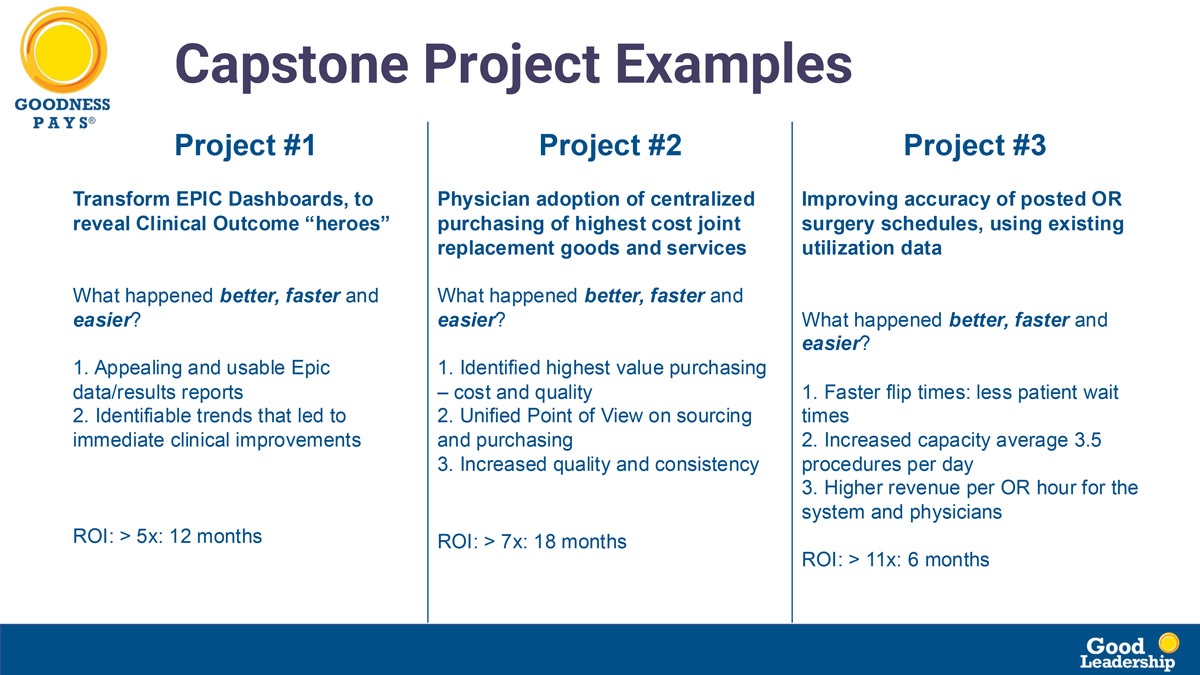
The Business Case Worksheet created a Return on Investment (ROI) mindset for each of the physicians as they launched into an organizational change initiative we call a Capstone Project. The lowest ROI equation was 5x over 18 months. Several of the capstone projects delivered more than 10x in one year. Every one of the physicians in the accelerator identified changes they were motivated to lead, but most had to be reminded to track the financial equation: how did the money spent lead to lower costs or higher revenue?
Here’s a picture of a slide that detailed the ROI of three capstone projects.
The physicians in the leadership accelerator program told us loud and clear: our society wants better access to high-quality care, and we all want it to cost less. After the program, they now see how they can be effective leaders, operating at the intersection of mission and margin, allowing them to redesign patient care, reduce provider burnout, and drive medical innovation without compromising clinical quality.
Follow this link to learn more about the Physician Leadership Accelerator. And send me an email, if you know someone who would benefit from this program.