


Inspiration and motivation are not the same. We can be inspired by someone or something that happens to us without acting on it. Motivation is the manifestation of inspiration turned into action.
So, today’s question is: What motivates you?
We’re so lucky to work with high-performing leaders like you who are also very high-functioning human beings. It makes every day both fascinating and rewarding. Everyone in the peer group works hard, everyone has goals, and when we ask, “What motivates you?” we find a wide variety of answers.
Business leaders most often share their obligation to shareholders, customers, or employees as their motivator. It makes sense. Human beings are relational creatures who crave the sense of belonging and meaning that comes from satisfying the needs of other people.
Opportunity or Threat?
When we ask executive teams the “What motivates you?” question, we see a common trend: those with a fuzzy set of motivations tend to produce mediocre results. Those who can articulate their motivation lead with more grit, more focus, more cohesiveness, and more mental toughness.
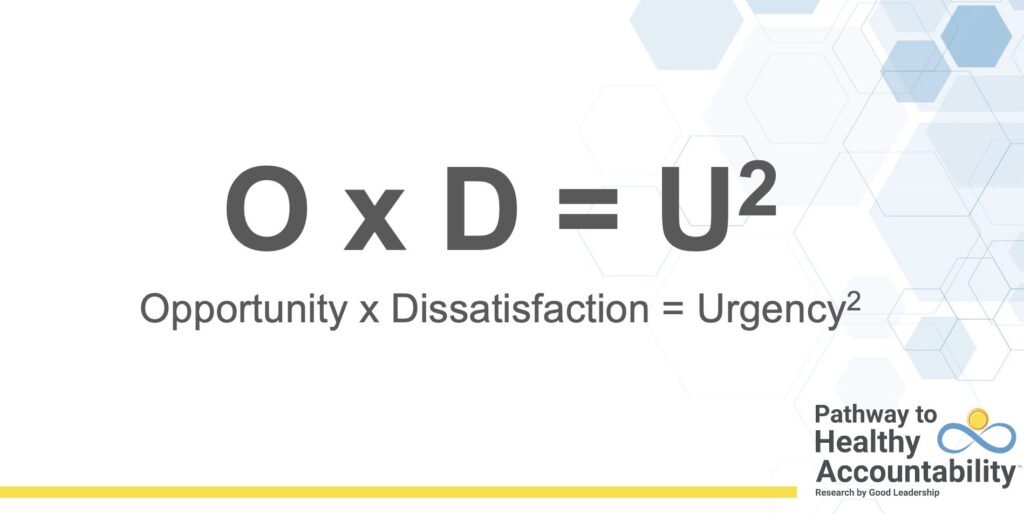
We use this formula to bring out the competitive fires in executive teams and to bring clarity to their motivations.
My colleague Kevin Sensenig and I wrote about this formula in the book Healthy Accountability – Chapter 15: Finding motivation for progress. The “O” stands for opportunity. The “D” stands for dissatisfaction, and the “U2” stands for urgency squared, representing the shared sense of urgency or the plurality required to make change. In full, it illustrates the energy created by opportunity and the energy created by dissatisfaction together create urgency for change. And when more than one person sees and feels that urgency, real change can happen.
So, this brings us back to question for today’s Chief Executive Insights: “What motivates you?”
17 years ago, when my wife and I started Good Leadership, we were motivated by the opportunity (O) to build something better for our family – but spurred into action because our (then) current situation was unacceptable. The dissatisfaction (D) was driving the urgency in the two of us (U2). That’s what typically happens – dissatisfaction drives courage and produces quick surges of endorphins from both fight and flight energy. But that energy fades quickly due to exhaustion – people simply can’t sprint for very long.
It’s the opportunity (O) energy that is more sustainable for the long haul. But it’s a lot harder to articulate and maintain. A little bit of energy from dissatisfaction keeps it fresh.
So, here’s the point: there needs to be an artful balance. For each Big Opportunity – that provides long-term motivation, we need three clearly-defined Dissatisfactions (often articulated as the Top 3 Can’t Miss Priorities) which provide short term bursts of motivational energy.
Shoot me a note: What is motivating you and how does that motivate your team?